
Permanent built-in ESD protection represents the pinnacle of electrostatic discharge control for transparent packaging, particularly for high-value electronics where both clarity and continuous protection are paramount. A fundamental and often misunderstood aspect of this technology is why the surface resistance of these advanced PET sheets is consistently engineered within the range of 10^9 to 10^11 ohms per square (Ω/sq). This report elucidates that this specific resistance window is not a limitation, but the direct result of a critical balance in material science. Achieving this optimal range requires a meticulously calibrated formulation and ratio of anti-static additives within the PET polymer matrix. Excessive loading, while potentially lowering resistance further, invariably introduces visual defects like crystallinity points, haziness, and post-thermoforming imperfections. This intricate formulation challenge underscores why Permanent built in ESD transparent PET sheet is a superior, high-performance alternative to temporary surface coatings, offering unmatched durability and reliability for critical applications.
1 Introduction: The Demand for Clarity and Permanent ESD Protection
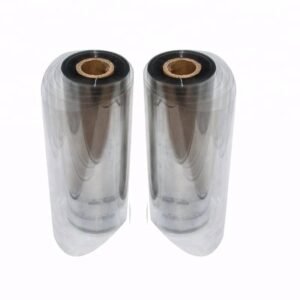
The electronics packaging industry faces a dual challenge: protecting sensitive components from Electrostatic Discharge (ESD) while allowing for product visibility and quality inspection. Transparent PET (Polyethylene Terephthalate) sheets are a preferred material due to their excellent clarity, mechanical strength, and formability.
While surface coatings can provide initial ESD protection, they are susceptible to wear, contamination, and environmental degradation. Permanent built-in ESD technology, where conductive or dissipative compounds are integrated directly into the polymer, solves these issues. However, engineering a material that is both optically clear and permanently anti-static presents a unique set of scientific and manufacturing hurdles, chief among them being the precise control of electrical and optical properties.
2 The Critical Resistance Range: 10^9-10^11 Ω/sq
2.1 The Functional “Sweet Spot” for ESD Protection
The target surface resistance of 10^9 to 10^11 Ω/sq is deliberately chosen as it falls squarely within the “dissipative” range as defined by leading ESD standards, including ANSI/ESD S20.20.It is just like the fuction of this Permanent Built-in ESD PET sheet – Yuanle.
Safe Charge Dissipation: This range provides a controlled, safe path for static charges to flow to ground, preventing a rapid discharge that could damage sensitive components. It is slow enough to prevent a sudden spark but fast enough to prevent dangerous charge accumulation.
Prevention of Static Build-Up: Materials in this range effectively neutralize static charges generated during handling and transportation, protecting enclosed electronics from potential ESD events.
2.2 The Formulation Barrier: Why Not More Conductive?
A logical question arises: if conductivity is good, why not add more additive to achieve a even lower resistance (e.g., 10^6 Ω/sq)? The answer lies in the fundamental incompatibility between high electrical conductivity and optical clarity in polymer systems.
3 The Core Challenge: Formulation and Ratio
The production of transparent, permanently anti-static PET is a delicate balancing act. The goal is to disperse just enough conductive additive to form a continuous dissipative network throughout the polymer without disrupting its crystalline and amorphous structure, which is responsible for its transparency.
3.1 The Science of the “Percolation Threshold”
The key concept is the “percolation threshold”—the critical concentration of conductive additive at which a continuous network is formed, causing a dramatic drop in electrical resistance. The objective in transparent PET is to operate just at or slightly above this threshold to achieve the desired 10^9-10^11 Ω/sq range with minimal impact on clarity.
3.2 The Consequences of Exceeding the Optimal Ratio
Exceeding the optimal additive ratio disrupts this delicate balance, leading to a host of quality issues that are often irreversible. This is where the true expertise in formulation is paramount.
Formation of Crystallinity Points (Fish-Eyes): An over-concentration of additive particles can act as nucleation sites, causing localized premature crystallization within the PET matrix. These appear as visible “crystallinity points” or “fish-eyes” in the extruded sheet, severely compromising optical quality.
Haziness and Loss of Clarity: Even without visible crystallinity points, an overload of particles scatters light as it passes through the sheet, resulting in general haziness, cloudiness, or a milky appearance. This defeats the primary purpose of using a transparent material.
Post-Forming Defects: The True Test: The most critical challenge arises during the vacuum thermoforming process. The sheet is reheated to its forming temperature, which can cause:
Increased Crystallization: The heat energy can exacerbate the crystallization process around additive agglomerations, creating new crystallinity points that were not visible in the initial sheet.
Stress Whitening and Streaking: Incompatibility between the polymer and an excessive amount of additive can lead to micro-fractures and polymer chain orientation under the stress of forming. This manifests as whitening, streaks, or uneven textures in the final formed product, rendering it aesthetically unacceptable.
Table: Consequences of Additive Overloading in Transparent PET
| Stage | Visual Defect | Root Cause |
|---|---|---|
| Sheet Extrusion | Crystallinity Points (Fish-Eyes) | Additive particles acting as nucleation sites for crystallization. |
| Sheet Extrusion | General Haziness & Cloudiness | Light scattering from an over-concentration of dispersed particles. |
| Vacuum Thermoforming | Stress Whitening / Streaking | Polymer-additive incompatibility and micro-fracturing under heat and stress. |
| Vacuum Thermoforming | Post-Forming Crystallinity | Reheating activates further crystallization around additive agglomerations. |
4 Permanent Built-in ESD vs. Surface Coating: A Fundamental Difference
This intricate formulation challenge highlights why permanent built-in ESD is technologically superior and more complex than surface coating (coating-outside).
Surface Coating (Coating-Outside): A temporary layer applied post-production. It is technologically simpler as it doesn’t require mastering the polymer’s internal structure. However, it is vulnerable to abrasion, chemical cleaning, and wear, leading to unreliable, non-permanent protection. Its performance can also be highly dependent on ambient humidity.
Permanent Built-in ESD: The anti-static property is an inherent, bulk material characteristic. Achieving this in a transparent form requires deep expertise in polymer science, extrusion, and additive compounding. The difficulty lies in creating a homogeneous, stable system where electrical performance and optical clarity coexist. This results in lifelong protection that cannot be worn off, is independent of the environment, and remains consistent even after forming.
5 Conclusion and Strategic Implications
The consistent 10^9 to 10^11 Ω/sq surface resistance of high-quality transparent PET sheets is not a shortcoming but a testament to precise engineering. It is the optimal balance between providing effective ESD protection and preserving the material’s essential visual and processing qualities.
Key Takeaways for the Industry:
Formulation is Paramount: The heart of manufacturing permanent built-in ESD transparent PET lies in the proprietary formulation and precise ratio of additives. This expertise is what separates high-performance materials from defective products.
Acknowledge the Complexity: The challenges of avoiding crystallinity points and post-forming defects place this technology in a different league of difficulty compared to simple surface coatings.
Value Long-Term Performance: For protecting high-value electronics in transparent packaging, the durability, reliability, and permanence of built-in ESD far outweigh the initial technical challenges, providing a lower total cost of ownership and superior product security.
For brands and manufacturers, partnering with a supplier that demonstrates a deep understanding of this formulation science is critical. It ensures the delivery of a product that is not only visually perfect but also delivers uncompromising, permanent ESD protection.
Seriously digging the bet979app. Super user-friendly, and I can easily track my bets while I’m out and about. Big fan! Download it here: bet979app
Alright, listen up! Found phfundownload, and it’s pretty straightforward for getting what you need. No BS, just downloads. Check it out yourself at phfundownload .
Izzicasino is one of my favorites! It’s super easy to deposit and withdraw funds. I’ve had nothing but perfect experiences! Check out what the hype is about: izzicasino